

Sidemount
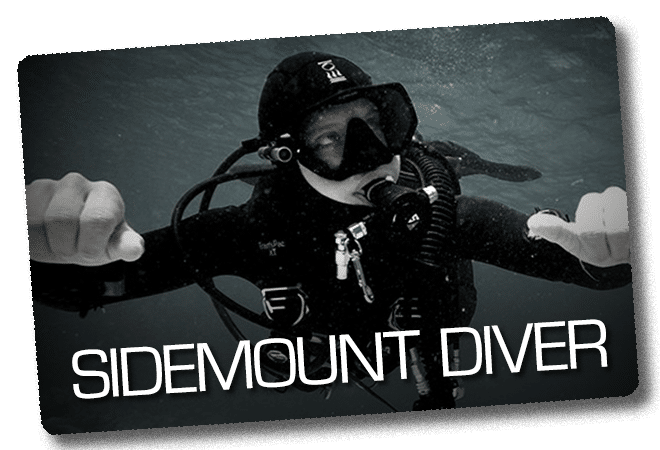
There is a perception that sidemount is something only cave divers use. The fact is, sidemount has many applications. There is more to sidemount than you might imagine. This can include:
- Rigging sidemount cylinders.
- Configuring sidemount regulators.
- Managing two separate gas supplies.
- Deciding which configuration approach best fits your body.
These are all things we cover in the Sidemount Diver course. The course generally takes just a single day and two dives.
Get started now
Just stop by the store or call (954) 792-4977.
This program generally takes just one day and two dives. With sufficient notice, we can usually offer this course when it’s most convenient for you.
- Be at least 15 years old.
- Be certified to at least the Open Water Diver level.
- Be able to answer No to all the questions on the medical questionnaire or obtain a physician’s approval for diving.
$799.95 person includes:
- All instruction
- eLearning
- Certification processing when earned
You supply:
- Mask and snorkel
- Adjustable scuba fins and wetsuit boots
- Adequate exposure protection
- Regulator system with alternate air source
- Sidemount harness, regulators and tanks
- Dive computer
- Underwater compass
- Dive knife/cutting tool
- Dive light
- SMB
Items you don’t already own are generally available for rent. Students are also responsible for gas fills and boat fees or dive site admission
There is a perception that sidemount is something only cave divers use. The fact is, sidemount has many applications. For example:
- Divers with back problems often sidemount so that they do not need to carry heavy tanks out of the water.
- Sidemount allows traveling tech divers to dive a twin-cylinder configuration even when manifolded doubles are not available. All they need are any two rental cylinders.
- Underwater photographers and videographers often prefer sidemount as it allows them to look up without banging their heads against a valve or manifold.
There is more to sidemount than you might imagine. This can include:
- Rigging sidemount cylinders.
- Configuring sidemount regulators.
- Managing two separate gas supplies.
- Deciding which configuration approach best fits your body.
These are all things we cover in the Sidemount Diver course.
In this course, we cover:
Equipment Considerations
- Cylinder options
- Regulator options
- Proper weighting and equipment configurations
- Emergency procedures
- Gas-sharing
- Proper reactions to gas hemorrhages
- Water entries
- Shore entry
- Boat entry
Dive 1
- Dive planning
- Monitor air and gas switching requirements
- Descend and do not exceed pre-planned limits
- Monitor and communicate depth/ time/ air consumption
- Demonstrate buoyancy control during cylinder manipulation
- Ascend and perform safety stop
Dive 2
- Dive planning
- Descend and do not exceed pre-planned limits
- Demonstrate buoyancy control during cylinder manipulation
- Demonstrate buoyancy control during gas switching
- Simulate out of air condition
- Simulate runaway power inflator
- Simulate loss of buoyancy
- Ascend and perform safety stop
Most importantly, we don’t practice these skills until you finally get them right. We have you repeat them until you can’t do them wrong.
Ask a question
Use this form to ask us about this specific class.